
Magnesium Glycinate for Sleep: What Evidence Supports (and What Labels Don’t)
Medical note: This article discusses foods and researched botanicals. It does not claim to prevent, treat, or cure disease. Supplements are not a substitute for food, and studied amounts are not personal prescriptions.
Direct answer
Magnesium glycinate is a highly bioavailable nutritional supplement frequently marketed to careful shoppers as a natural sleep aid. It is not a sedative, nor is it a cure for clinical insomnia. Instead, it may help support better sleep quality by promoting physical relaxation and normal nerve function, particularly if your daily diet lacks adequate amounts of this essential mineral.
The primary advantage of choosing magnesium glycinate over other inexpensive forms on the pharmacy shelf is its tolerability. Because the magnesium is bound to the amino acid glycine, it is easily absorbed and significantly less likely to cause the gastrointestinal side effects—specifically diarrhea—associated with poorly absorbed forms like magnesium oxide. While general magnesium supplementation has been studied for its potential to support sleep in older adults, robust randomized controlled trials explicitly testing the glycinate form specifically for sleep disorders are notably limited. It is a highly logical choice for addressing a dietary shortfall, but it should be viewed as a supportive daily nutrient rather than a fast-acting sleeping pill.
What magnesium does and what glycinate is/isn’t
To understand why this supplement is popular for relaxation, it is important to separate the mineral itself from its delivery vehicle.
The Role of Magnesium Magnesium is a vital cofactor in more than 300 enzyme systems that regulate diverse biochemical reactions in the human body. It is required for protein synthesis, muscle and nerve function, blood glucose control, and blood pressure regulation. It is also fundamentally involved in cellular energy production. In the context of relaxation, magnesium plays a crucial role in supporting normal nerve transmission and healthy muscle contraction. An underlying inadequate intake can lead to subtle disruptions in these systems, making physical relaxation difficult.
What is Glycinate? Minerals cannot easily be consumed on their own; they are typically bound to another molecule for stability. Magnesium glycinate (or bisglycinate) is elemental magnesium chemically bound to molecules of glycine. Glycine is an amino acid that the body uses to create proteins. In the central nervous system, glycine also acts as an inhibitory neurotransmitter. By combining magnesium and glycine, supplement manufacturers aim to deliver a compound that supports relaxation through both the mineral and the amino acid.
What It Isn’t Magnesium glycinate is not a central nervous system depressant or a synthetic hormone. Taking it will not forcibly shut down your brain or induce immediate drowsiness. It is merely a dietary supplement designed to ensure your nervous system has the raw materials required to function normally.
Evidence snapshot
When shopping for supplements, it is critical to separate biological plausibility from clinical evidence. Here is a snapshot of the current science.
| The Claim | The Evidence | The Realistic Expectation |
|---|---|---|
| Magnesium cures insomnia | General magnesium supplementation shows mixed results in trials. Some studies indicate it may support subjective measures of sleep in older adults. | It is not a cure for disease. It may help improve sleep quality, particularly if correcting an inadequate dietary intake. |
| Magnesium Glycinate is clinically proven for sleep | There is a distinct lack of large-scale, randomized controlled trials explicitly testing the glycinate form against a placebo specifically for sleep disorders. | The reputation of glycinate for sleep relies on theoretical mechanisms (muscle relaxation from magnesium plus inhibitory action from glycine) rather than robust clinical trials. |
| Glycine independently improves sleep | Small-scale independent studies suggest 3 grams of glycine before bed may improve sleep quality. | Most magnesium glycinate supplements do not contain a full 3-gram dose of glycine. The glycine amount is a fractional byproduct. |
Practical Guidance
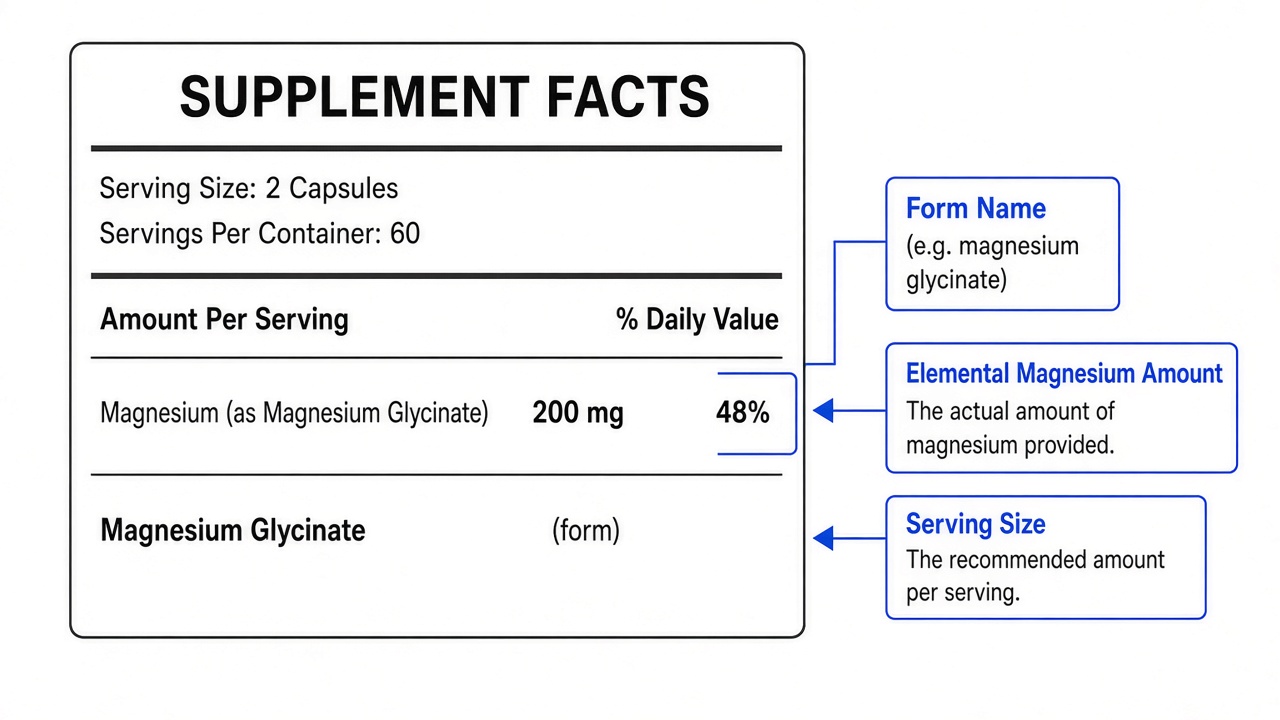
Buying magnesium requires navigating confusing labels and understanding how your digestive tract handles different compounds. This section covers the essential information careful shoppers need.
Decoding the Label: Elemental Magnesium
The single most common mistake shoppers make is misreading the dosage on a supplement label. When you pick up a bottle, the front label might boldly claim “1,000 mg.” However, this number typically represents the total weight of the entire compound (the magnesium plus the heavy glycine molecules), not the actual amount of active mineral.
Because glycine is relatively heavy, magnesium glycinate is roughly 10% to 14% elemental magnesium by weight. To know exactly how much magnesium you are ingesting, you must look at the Supplement Facts panel on the back of the bottle.
Look for the specific line that says: Magnesium (as Magnesium Glycinate) ….. 120 mg
That “120 mg” is the elemental magnesium. Always dose based on the elemental magnesium listed on the back panel, rather than the misleading total compound weight on the front.
Comparing Magnesium Forms
Not all magnesium supplements behave the same way in the human body. Here is how glycinate compares to other forms often found on pharmacy shelves:
- Magnesium Glycinate/Bisglycinate: Highly bioavailable and gentle on the stomach. It is the preferred choice for those seeking relaxation support without gastrointestinal distress.
- Magnesium Oxide: The cheapest and most common form. It has poor bioavailability and is frequently associated with diarrhea. It is not recommended for relaxation purposes.
- Magnesium Citrate: A moderately priced form bound to citric acid. It has good absorption but acts as a mild to moderate laxative.
- Magnesium Chloride and Carbonate: These forms, along with oxide and gluconate, are the most commonly associated with diarrhea.
Realistic Dose and Use
The Recommended Dietary Allowance (RDA) for elemental magnesium is 400–420 mg for adult men and 310–320 mg for adult women.
However, the Food and Nutrition Board has established a specific Tolerable Upper Intake Level (UL) for supplemental magnesium at 350 mg per day for adults. This limit applies exclusively to magnesium obtained from dietary supplements and medications, not to magnesium naturally occurring in food.
For sleep support, a realistic approach is to take 100 mg to 200 mg of elemental magnesium (from glycinate) about 1 to 2 hours before bedtime. This supportive dose stays well under the 350 mg UL, reducing the risk of adverse effects.
Food First vs. Supplementation
Supplements should never replace a balanced diet. Getting nutrients from food is ideal because foods provide a complex matrix of essential vitamins, minerals, and fibers that work synergistically. Furthermore, healthy kidneys are highly efficient at regulating magnesium absorbed from food by excreting any excess in the urine.
Rich sources of dietary magnesium include:
- Roasted pumpkin seeds
- Spinach and Swiss chard
- Almonds, cashews, and peanuts
- Black beans and edamame
- Brown rice and oatmeal
If your diet is heavily dependent on processed foods and refined grains (which have magnesium stripped away during processing), you may have an inadequate intake. In this case, a glycinate supplement is a rational addition.
Avoiding the Dreaded Diarrhea (Side Effects)
The most notorious side effect of magnesium supplementation is osmotic diarrhea. This occurs when unabsorbed magnesium salts sit in the colon and draw water into the intestines, accelerating bowel movements and causing cramping.
Forms most commonly associated with diarrhea are magnesium carbonate, magnesium chloride, magnesium gluconate, and magnesium oxide.
Magnesium glycinate minimizes this risk. Because the magnesium is tightly bound to glycine, it is absorbed efficiently through the intestinal wall. This efficient absorption leaves very little residual magnesium in the colon to attract water. For individuals with sensitive stomachs, glycinate is the safest choice to avoid gastrointestinal upset.
Safety

While magnesium is generally safe for healthy individuals, supplementation requires careful consideration of potential risks.
Kidney Function: Healthy kidneys eliminate excess dietary magnesium in the urine. However, individuals with impaired kidney function or chronic kidney disease cannot clear magnesium efficiently. For these individuals, taking supplements can lead to a dangerous buildup of the mineral in the blood (hypermagnesemia), causing muscle weakness, dangerously low blood pressure, and cardiac issues. Never take magnesium supplements if you have kidney disease without direct medical supervision.
Medication Interactions: Magnesium supplements can interact with common medications. They can bind to certain antibiotics, such as tetracyclines and fluoroquinolones, severely reducing their absorption. They can also interfere with bisphosphonates used for osteoporosis. Additionally, individuals taking diuretics or proton pump inhibitors (PPIs) may experience altered magnesium levels. Always consult a pharmacist regarding interactions. Toxicity from food sources is rare, but high doses of supplements can be dangerous. Adhere strictly to the 350 mg UL for supplements.
FAQ
How quickly does magnesium glycinate work for sleep? Magnesium is not an acute sedative. You will not feel an immediate, heavy drowsiness 30 minutes after taking it. Most users report that if it helps, they notice a subtle physical relaxation and easier transition to sleep within a few days to a week of consistent use. Correcting a dietary shortfall takes time.
Can I take magnesium glycinate every night? Yes, it is generally safe for healthy adults to take daily, provided you are staying below the 350 mg Upper Intake Level (UL) for supplemental magnesium. Many use it as a standard part of their nightly routine to support overall nervous system health.
What happens if I take too much magnesium glycinate? Even with the highly absorbable glycinate form, the first sign of taking too much is usually digestive upset, including loose stools or mild cramping. At dangerously high doses well above the UL, symptoms can progress to lethargy, facial flushing, and a dangerous drop in blood pressure.
Is magnesium glycinate the same as magnesium bisglycinate? Yes, they are the exact same compound. The prefix “bis” means “two,” referring to the fact that one magnesium atom is bound to two glycine molecules. Supplement manufacturers use the terms interchangeably on their labels.
Related
Medical Disclaimer
Medical Disclaimer: The information provided in this guide is for educational and informational purposes only and is not intended as medical advice. OTCFood.com does not claim to diagnose, treat, cure, or prevent any disease. Always consult with a qualified healthcare professional before starting any new dietary supplement, especially if you have pre-existing health conditions like kidney disease or are taking prescription medications.
Sources
National Institutes of Health, Office of Dietary Supplements. “Magnesium: Fact Sheet for Health Professionals.” https://ods.od.nih.gov/factsheets/Magnesium-HealthProfessional/