Rhodiola Rosea for Stress and Fatigue: What Evidence Supports
Medical note: This article discusses foods and researched botanicals. It does not claim to prevent, treat, or cure disease. Supplements are not a substitute for food, and studied amounts are not personal prescriptions.
Direct Answer: What the Evidence Does and Does Not Support
Human research investigating Rhodiola rosea for stress and fatigue is limited, mixed, and frequently of low-to-moderate quality. Current scientific evidence does not support claims that rhodiola can cure, treat, prevent, or heal medical conditions such as clinical burnout, chronic fatigue syndrome, or major depressive disorder.
Evidence indicates that rhodiola is studied for its potential to modulate the body’s response to mild physical and psychological stressors. Systematic reviews suggest rhodiola may help alleviate subjective mental fatigue and support cognitive performance during acute, short-term stress (such as shift work or academic exams). However, results are frequently contradictory, and many trials suffer from methodological flaws, small sample sizes, or a high risk of bias. While rhodiola supports ongoing clinical interest for managing perceived stress, there is not enough high-quality evidence to definitively confirm its efficacy for any specific health purpose.
What Is Rhodiola Rosea?
Rhodiola rosea is a perennial flowering plant native to the cold, high-altitude climates of Europe, Asia, and North America. Historically consumed in Russia and Scandinavia to support physical endurance in harsh environments, it is commonly known as golden root or arctic root.
Researchers and formulators primarily focus on two classes of bioactive phytochemicals within the root: rosavins (including rosavin, rosin, and rosarin) and salidroside (rhodioloside). While these compounds serve as markers for commercial standardization, it remains undetermined which specific compounds—or synergistic combinations—drive the physiological effects observed in clinical settings.
Commercially, rhodiola is aggressively marketed as an “adaptogen.” It is vital to recognize that “adaptogen” is a term rooted in traditional-use history and marketing framing, not a proven pharmacological mechanism. The concept suggests these substances non-specifically increase the body’s resistance to stress. While this framing drives consumer interest, rigorous clinical frameworks and regulatory agencies do not recognize “adaptogen” as a specific medical or therapeutic classification.
Evaluating the Evidence
| Evidence Question | What the Cited Sources Support | Practical Reading |
|---|---|---|
| Does it reduce perceived stress? | Studies suggest it may help modulate the stress response and alleviate subjective life stress, but methodological flaws limit definitive conclusions. | It is studied for mild, non-clinical stress support, but should never replace evidence-based anxiety therapies. |
| Does it improve mental fatigue? | Some trials report it supports mental performance and reduces subjective fatigue during prolonged concentration; systemic data remains mixed. | It may help with temporary cognitive exhaustion, but high-quality proof of sustained energy enhancement is elusive. |
| What are the research limitations? | The NCCIH and systematic reviews explicitly note human trials are mostly low-to-moderate quality, lacking robust bias-reducing mechanisms. | Consumers should view aggressive marketing claims with skepticism; the underlying science is preliminary. |
| Is it safe for daily use? | NCCIH notes it is possibly safe for up to 12 weeks in healthy adults, though specific drug interactions and mild side effects occur. | Short-term trials indicate general tolerability, but robust, long-term safety data is currently missing. |
Consumer Guide: Products, Standardization, and Realistic Use
How Products Are Sold and Formulated
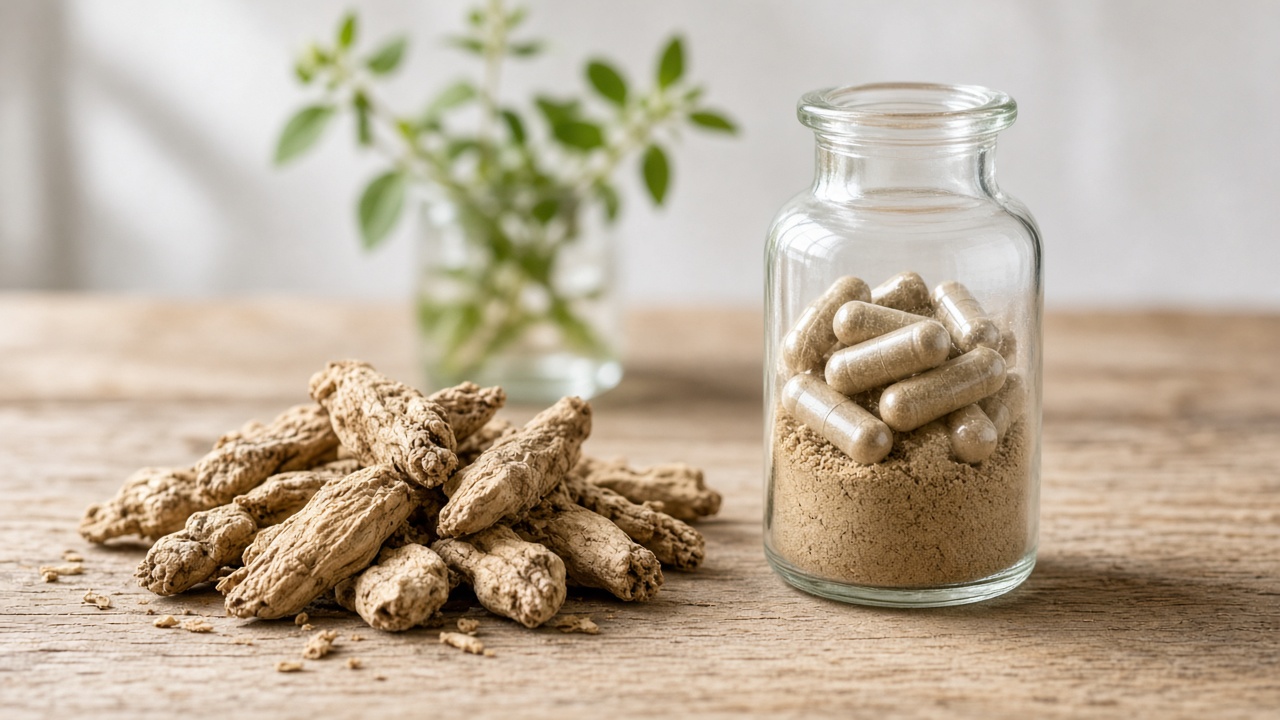
Rhodiola rosea is available in encapsulated powders, pressed tablets, liquid alcohol tinctures, and teas. Within the clinical literature, the heavily researched SHR-5 extract (a specific water-and-ethanol extraction) was utilized in several early Scandinavian fatigue trials. The broader dietary supplement market frequently attempts to mimic this clinical profile using generic extracts.
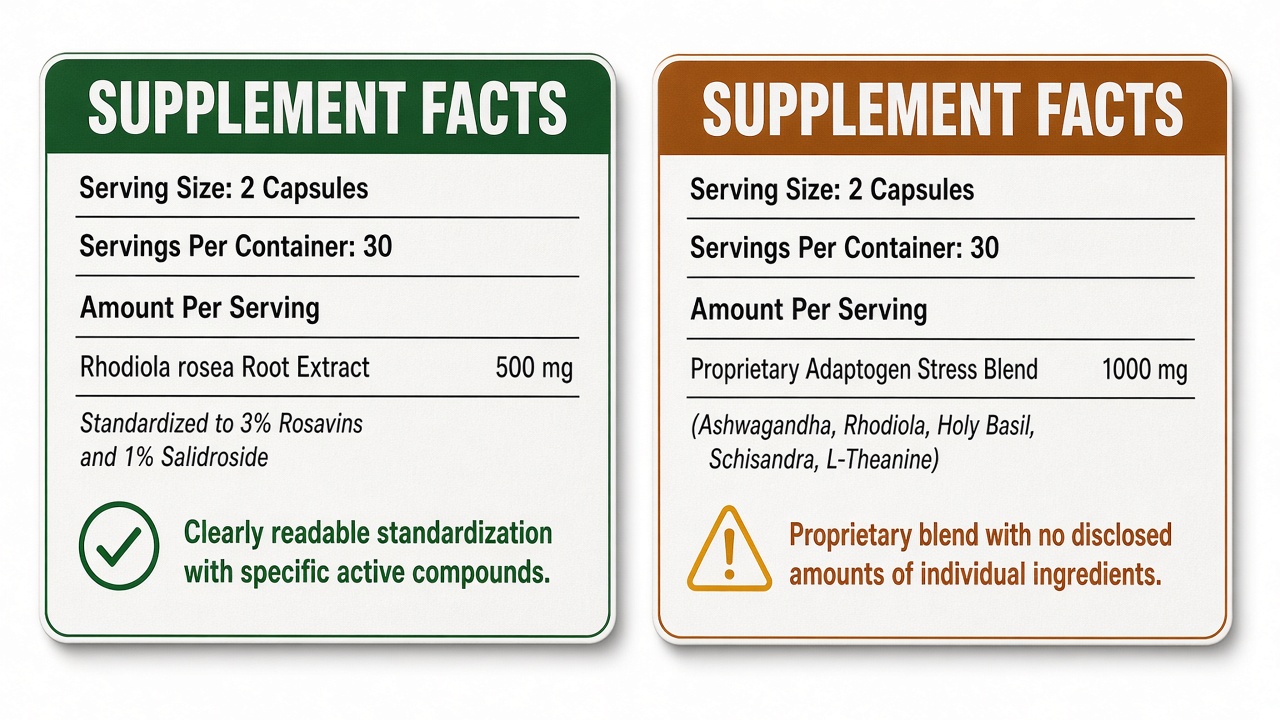
Most modern commercial extracts are standardized to ensure batch-to-batch consistency of specific marker compounds. Dietary supplement products typically claim standardization to 3% rosavins and 1% salidroside, a ratio heavily marketed because it mirrors the naturally occurring balance found in the authentic root.
Why Standardization is Not Proof of Effect
Seeing “3% rosavins / 1% salidroside” on a label suggests a baseline of manufacturing quality, but it does not guarantee clinical efficacy. Because researchers have not isolated a single active constituent dictating rhodiola’s mechanism, standardizing to these two markers is merely a proxy for raw material quality. Higher percentages of rosavins do not equate to a more potent physiological response. Furthermore, strict standardization often fails to account for synergistic compounds—such as flavonoids and organic acids—that might be lost during chemical extraction.
The Problem of Adulteration
Botanical adulteration is a pervasive issue in the global rhodiola market. Because the plant grows slowly in extreme environments and takes up to five years to mature, raw material costs are exceptionally high. This supply chain vulnerability leads to frequent, intentional species substitution.
Products are frequently cut with or replaced by cheaper species (such as Rhodiola crenulata). These alternatives may contain salidroside but typically lack the rosavin profile entirely and do not share the same clinical research trajectory. Consumers must look for stringent third-party testing certifications (e.g., NSF International, USP, ConsumerLab) to verify species authenticity and rule out adulteration.
Study Doses vs. Label Servings
Clinical trials investigating subjective stress and mental fatigue typically utilize daily doses ranging from 200 mg to 600 mg of a standardized extract. In contrast, commercial label servings vary wildly, sometimes offering 1,000 mg or more, or hiding the dose inside a proprietary “stress blend.”
Current evidence supports staying within the clinically studied parameters of 200 mg to 600 mg. Based on the pharmacological concept of hormesis (a bell-shaped dose-response curve common in botanicals), excessively high doses may actually decrease potential benefits while increasing the likelihood of adverse side effects like jitteriness.
Timing and Trial Periods
Because rhodiola is frequently reported to have a mild, non-caffeinated stimulating effect, clinical protocols generally administer the botanical early in the day.
Botanical interventions require a realistic trial period. Studies evaluating rhodiola often measure subjective outcomes over 2 to 6 weeks. If a user does not perceive a difference in subjective fatigue or stress resilience after 4 to 6 weeks of consistent morning use at a clinically relevant dose, evidence suggests it may not be an effective intervention for their specific biology.
Who Should Skip Rhodiola?
Given the low-to-moderate quality of evidence and potential for central nervous system stimulation, several demographics should bypass rhodiola entirely:
- * Individuals with bipolar disorder: Due to theoretical risks of inducing mania, avoiding pseudo-stimulants is standard practice.
- * Those with severe insomnia: The potential mildly stimulating effects can exacerbate sleep disorders.
- * Individuals seeking mental health treatment: Those with clinical depression or anxiety must avoid using rhodiola as a substitute for care, as it is not proven to treat these psychiatric conditions.
Rhodiola vs. Other Stress Botanicals
Within the adaptogen category, rhodiola is frequently compared with ashwagandha and maca.
- Rhodiola vs. Ashwagandha: Rhodiola is primarily studied for acute mental fatigue and cognitive endurance, presenting an uplifting profile. Ashwagandha (Withania somnifera*) is studied for lowering perceived stress and supporting sleep onset, presenting a more calming or sedating profile.
- Rhodiola vs. Maca: Maca lacks the rosavin and salidroside profile entirely. It is a root vegetable (Lepidium meyenii*) marketed for libido, featuring a completely different traditional use history and clinical trajectory than high-altitude rhodiola.
Safety, Tolerability, and Interactions
The National Center for Complementary and Integrative Health (NCCIH) states that Rhodiola rosea is possibly safe when taken by mouth for up to 12 weeks. Robust, long-term safety data beyond this window has not been rigorously established in large-scale human clinical trials.
When adverse events are reported, they are generally mild and may include:
- * Dizziness
- * Headache
- * Insomnia (especially if administered late in the day)
- * Dry mouth or excessive saliva production
Medication Interactions: Rhodiola may alter how the body metabolizes specific prescription medications. Specific interactions between rhodiola and losartan (a blood pressure medication) have been documented. It may also theoretically interact with antidepressants, monoamine oxidase inhibitors (MAOIs), anti-anxiety medications, and pharmaceutical stimulants. Always ask a clinician or pharmacist before adding rhodiola to your regimen if taking prescription or over-the-counter medications.
Pregnancy and Breastfeeding: There is a critical lack of reliable safety data regarding Rhodiola rosea during pregnancy or while breastfeeding. Due to this absence of evidence regarding fetal development and breast milk transfer, its use is not supported for these populations.
Regulatory Note: Rhodiola rosea supplements are not approved by the Food and Drug Administration (FDA) before market release. Manufacturers are solely responsible for evaluating the safety and labeling of their own products, underscoring the importance of choosing reputable, third-party-tested brands.
Frequently Asked Questions
Is rhodiola proven to cure burnout?
No. Current scientific evidence does not support claims that rhodiola can cure or treat burnout. It is studied for its potential to help alleviate subjective symptoms of mental fatigue, but research remains mixed.
Does rhodiola work immediately for energy?
Rhodiola is not an acute stimulant like caffeine. While some users report subjective effects within days, clinical studies generally measure physiological outcomes related to fatigue and stress resilience over 2 to 6 weeks.
Can I take rhodiola at night?
It is generally not recommended. Because rhodiola is frequently studied for its potential mildly stimulating effects on cognitive performance, taking it late in the afternoon or evening may disrupt normal sleep architecture.
Why do some rhodiola supplements not work?
Lack of perceived efficacy can stem from poor-quality extracts, species substitution (using a cheaper plant lacking rosavins), label doses that do not align with clinical literature, or an individual’s unique non-response to the botanical.
Related Guides
Medical Disclaimer
This article is for educational purposes only. The information provided has not been evaluated by the Food and Drug Administration. This product is not intended to diagnose, treat, cure, or prevent any disease. Always consult a qualified healthcare professional before starting any new dietary supplement.
Sources
- 1. National Center for Complementary and Integrative Health (NCCIH). “Rhodiola: Usefulness and Safety.” U.S. Department of Health and Human Services, National Institutes of Health. https://www.nccih.nih.gov/health/rhodiola
- 2. Ishaque, S., Shamseer, L., Bukutu, C., & Vohra, S. “Rhodiola rosea for physical and mental fatigue: a systematic review.” BMC Complementary and Alternative Medicine, 2012. https://pubmed.ncbi.nlm.nih.gov/22643043/
- 3. Ivanova Stojcheva, E., & Quintela, J. C. “The Effectiveness of Rhodiola rosea L. Preparations in Alleviating Various Aspects of Life-Stress Symptoms and Stress-Induced Conditions-Encouraging Clinical Evidence.” Molecules, 2022. https://pubmed.ncbi.nlm.nih.gov/35745023/