
Magnesium Glycinate for Sleep: What Evidence Supports (and What Labels Don’t)
Medical note: This article discusses foods and researched botanicals. It does not claim to prevent, treat, or cure disease. Supplements are not a substitute for food, and studied amounts are not personal prescriptions.
Magnesium glycinate may help sleep-onset latency—the time it takes to fall asleep—in some older adults with insomnia, but the supporting evidence is limited and low quality. Reviews have found conflicting results, and there is not enough rigorous evidence to treat magnesium glycinate as a proven insomnia intervention. It should not replace sleep medicine or clinical care.
What magnesium is—and isn’t—for sleep searchers
Magnesium is an essential mineral found naturally in foods and also available in supplements and some medicines. Its presence in the body does not prove that taking extra magnesium will improve sleep.
Interest in magnesium for sleep has grown alongside social trends such as the “sleepy girl mocktail.” Social popularity and supplement marketing are not the same as clinical evidence. The National Center for Complementary and Integrative Health (NCCIH) states that there is very little rigorous evidence that magnesium supplements work for insomnia or other sleep disorders.
For people searching for a sleep supplement, magnesium is best viewed as a possible supportive option—not a guaranteed sedative, an established treatment for insomnia, or a replacement for medical evaluation.
Evidence snapshot
| Hopeful claim | What NCCIH/ODS actually say | Confidence |
|---|---|---|
| Magnesium glycinate cures insomnia | NCCIH reports very little rigorous evidence that magnesium supplements work for insomnia or other sleep disorders. | None |
| Magnesium helps people fall asleep faster | A 2021 review of three studies (151 people) suggested magnesium may help sleep-onset latency in older adults with insomnia. Evidence was low quality and inadequate for decisions. | Low |
| Magnesium improves sleep quality | A 2022 review of nine studies found conflicting results. Larger RCTs lasting longer than 12 weeks are needed. | Low |
| High-dose magnesium is harmless | Supplemental magnesium above the upper limit can cause diarrhea, nausea, and cramping. Extreme intakes may cause irregular heartbeat or cardiac arrest. | None |
Label-reading and magnesium form guide
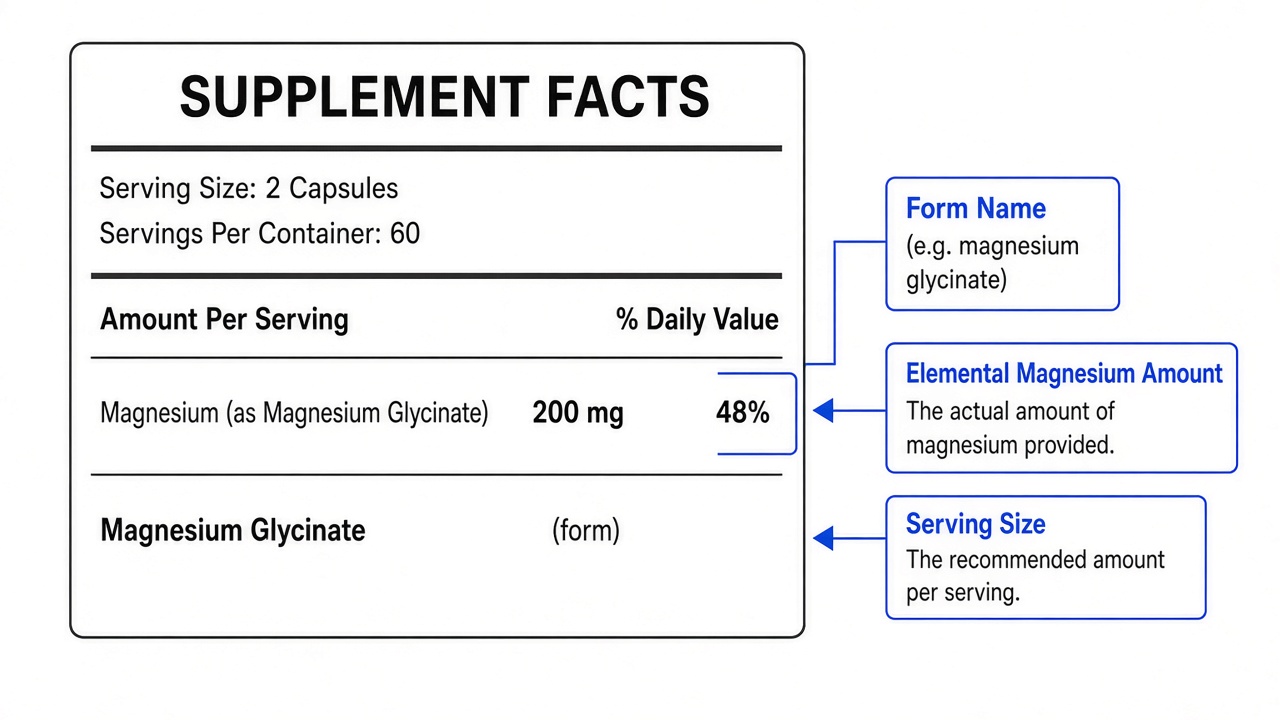
The form listed on a bottle is only one part of the label. Before comparing magnesium glycinate with citrate or oxide, look for the amount of magnesium supplied per serving, the serving size, and the form named in the Supplement Facts panel.
Elemental magnesium
“Elemental magnesium” refers to the amount of magnesium supplied by the compound. A label may name magnesium glycinate, citrate, or oxide, but the amount that matters for tracking supplemental magnesium is the magnesium amount in Supplement Facts.
Check whether the amount is per capsule, tablet, or scoop, and how many units make one serving. The front of a bottle may emphasize the form name; the Supplement Facts panel is the better place to track the stated magnesium amount.
Why magnesium glycinate is trendy
Magnesium glycinate is popular in sleep marketing and is often presented as a premium nighttime form. That popularity helps explain why shoppers see it repeatedly in ads and sleep-focused formulas.
The NIH Office of Dietary Supplements (ODS) does not single out glycinate as the best or most absorbable form. Its consumer fact sheet lists magnesium aspartate, citrate, lactate, and chloride among forms that are better absorbed. Glycinate may be a reasonable preference for some shoppers, but the public sources do not establish that it is uniquely effective for sleep.
Label phrases such as “calming,” “nighttime,” or “sleep support” should be treated as marketing language unless supported by appropriate evidence. The form name alone does not establish a sleep benefit.
Glycinate vs citrate vs oxide
- Magnesium glycinate: Widely marketed for sleep, but NCCIH and ODS do not identify it as a proven sleep form or as the best-absorbed option. Look at the elemental magnesium amount.
- Magnesium citrate: ODS lists citrate among better-absorbed forms. Citrate is also common in laxative products—watch serving size and GI symptoms.
- Magnesium oxide: Not among the forms ODS specifically lists as better absorbed. Do not assume one form is always gentler.
Across forms, excessive supplemental magnesium can cause diarrhea, nausea, and cramping. If a product causes symptoms, do not assume a higher dose will improve sleep.
The 350 mg-per-day upper limit
For adults, the tolerable upper intake level (UL) for magnesium from dietary supplements and medications is 350 mg per day. This is a safety limit for supplemental sources, not a recommended “sleep dose.”
The UL does not apply to magnesium naturally present in food. Add up capsules, powders, antacids, and laxatives that contain magnesium—not only the nighttime bottle.
There is no established magnesium dose for sleep in the supplied NCCIH and ODS information. Staying below the UL does not prove a supplement will improve insomnia.

When to ask a clinician
Ask a clinician before using a magnesium supplement if you have kidney disease or take medications. Bring the product label: form, elemental magnesium amount, serving size, and other ingredients.
Safety and who should skip it
Supplemental magnesium above the UL may cause diarrhea, nausea, and abdominal cramping. Extreme intakes carry more serious risks, including irregular heartbeat and cardiac arrest.
Do not use high-dose magnesium as a substitute for evaluating persistent sleep problems. People with kidney disease should seek medical guidance before taking magnesium. Anyone on medications should check with a clinician or pharmacist.
Frequently asked questions
How much magnesium should I take for sleep?
There is no established, evidence-based magnesium sleep dose in the supplied sources. The adult UL is 350 mg per day from supplements and medications, but that limit is not a proven sleep target.
Does magnesium cause diarrhea?
It can. NCCIH and ODS state that supplemental magnesium above the UL may cause diarrhea, nausea, and cramping. Extreme intakes can create more serious risks.
Is magnesium glycinate better than citrate?
ODS does not single out glycinate as the best form. It lists aspartate, citrate, lactate, and chloride among forms that are better absorbed. Sleep evidence does not establish glycinate as a superior sleep option.
Does the 350 mg limit apply to magnesium in food?
No. The UL applies to magnesium from dietary supplements and medications, not magnesium naturally present in food.
How this differs from related OTCFood guides
This article focuses on magnesium glycinate for sleep, evidence quality, labels, forms, elemental magnesium, and the supplemental UL.
For a broader comparison of foods and botanicals used in sleep routines, see Foods and Botanicals People Use for Sleep — Ranked Honestly.
For safety notes on another commonly discussed supplement, see Ashwagandha Side Effects, Interactions, and Who Should Skip It.
Medical disclaimer
This article is for informational and educational purposes only and is not medical advice. Talk with a qualified healthcare professional before starting a dietary supplement, particularly if you have kidney disease, take medications, or have persistent sleep problems. Dietary supplements are not intended to diagnose, treat, cure, or prevent disease.
Sources
- NCCIH — Magnesium Supplements for Sleep Disorders
- NIH ODS — Magnesium Fact Sheet for Consumers
- NCCIH — Sleep Disorders and Complementary Health Approaches