Creatine Monohydrate: What Evidence Supports (Beyond Gym Myths)
Medical note: This article discusses foods and researched botanicals. It does not claim to prevent, treat, or cure disease. Supplements are not a substitute for food, and studied amounts are not personal prescriptions.
Direct Answer
For careful shoppers navigating sports nutrition, creatine monohydrate is one of the most rigorously studied dietary supplements. According to the National Institutes of Health (NIH) Office of Dietary Supplements, evidence strongly supports that creatine may help improve strength, increase power output, and enhance performance during short, intermittent bursts of high-intensity exercise.
Unlike supplements relying on isolated animal models, creatine’s human efficacy is backed by decades of controlled trials. It functions by expanding phosphocreatine reserves, which muscle cells utilize to rapidly regenerate energy during maximum exertion.
The evidence is highly specific. While it supports high-intensity, short-duration output—like sprinting or heavy weightlifting—the NIH notes it provides little to no benefit for purely endurance-based sports. For healthy adults, it is safe at recommended dosages. The most common side effect is mild weight gain, attributed to water retention within muscle tissue. Consumers are advised to seek pure creatine monohydrate, avoiding proprietary blends that inflate costs without providing clinical benefits.
What It Is / Isn’t
To use creatine effectively, consumers must understand its biological role. Creatine is a naturally occurring compound synthesized in the liver and kidneys from the amino acids arginine, glycine, and methionine. Approximately 95% of the body’s creatine is stored in skeletal muscle. It is also consumed naturally through red meat and seafood. However, achieving muscle saturation for performance enhancement generally requires supplementation.
What Creatine Is:
- An Energy Facilitator: Muscle cells run on adenosine triphosphate (ATP). When a muscle contracts, ATP releases a phosphate group to provide energy, becoming adenosine diphosphate (ADP). Stored phosphocreatine rapidly donates a phosphate group back to the ADP, regenerating ATP. This allows for a few extra seconds of maximum energy output.
- An Osmolyte: Creatine draws water into the muscle cell (cell volumization), playing a direct role in cellular hydration.
What Creatine Isn’t:
- An Anabolic Steroid: Creatine is entirely unrelated to synthetic hormones and does not alter the endocrine system.
- A Stimulant: Unlike caffeine, it does not stimulate the central nervous system. It provides no immediate rush of energy; its effects rely entirely on long-term cellular saturation.
- A Magic Muscle Builder: It does not build muscle passively. It simply provides the cellular energy capacity to perform an extra repetition, facilitating the physical stimulus that drives adaptation.
Evidence Snapshot
The following table summarizes the current evidence consensus based on data from the NIH Office of Dietary Supplements regarding creatine for performance.
| Application/Claim | Level of Evidence | Practical Takeaway |
|---|---|---|
| Short-Burst Strength & Power | Strong | May help increase maximum power output in resistance training and short sprints. |
| Endurance Performance | Weak / None | Provides little to no benefit for distance running, endurance cycling, or steady-state aerobics. |
| Lean Body Mass Increase | Moderate to Strong | May help increase lean tissue over time by allowing greater training volume and intracellular water retention. |
| Safety in Healthy Adults | Strong | Well-tolerated at standard doses (3–5g daily); primary side effect is temporary water-based weight gain. |
| Superiority of Novel Forms (e.g., HCL) | Weak | No robust evidence suggests newer, expensive forms outperform standard creatine monohydrate. |
Practical Guidance: Label Reading, Loading vs Daily 3–5g, and Water Weight
Navigating the supplement market requires careful scrutiny to avoid inflated prices and unsubstantiated claims. This section details how to select a product, dose it effectively, and understand physiological changes.
How to Choose: Mastering the Supplement Label
When purchasing creatine, prioritize simplicity. Clinical research demonstrating safety and efficacy predominantly utilizes one specific form: creatine monohydrate.
- Look for 100% Pure Creatine Monohydrate: Read the “Supplement Facts” panel. The only ingredient should be Creatine Monohydrate. Avoid products with long lists of artificial colors, sweeteners, or “proprietary blends.” These mask under-dosed ingredients that provide zero extra benefit.
- The Creapure® Distinction: Creapure is a highly purified form of creatine monohydrate manufactured in Germany. While standard, unbranded monohydrate from a reputable third-party tested brand is highly effective, careful shoppers seeking maximum manufacturing purity and minimal degradation byproducts often prefer Creapure.
- Avoid “Next Generation” Creatines: Companies frequently market newer forms (e.g., Creatine Ethyl Ester, Creatine HCL) claiming superior absorption. Scientific literature does not support these claims. Alternative forms do not outperform standard monohydrate and are universally more expensive per serving.
Dosing Strategies: The Loading Phase vs Daily 3–5g
Because creatine works by saturating muscle cells over time, timing matters far less than daily consistency. There are two established ways to reach saturation:
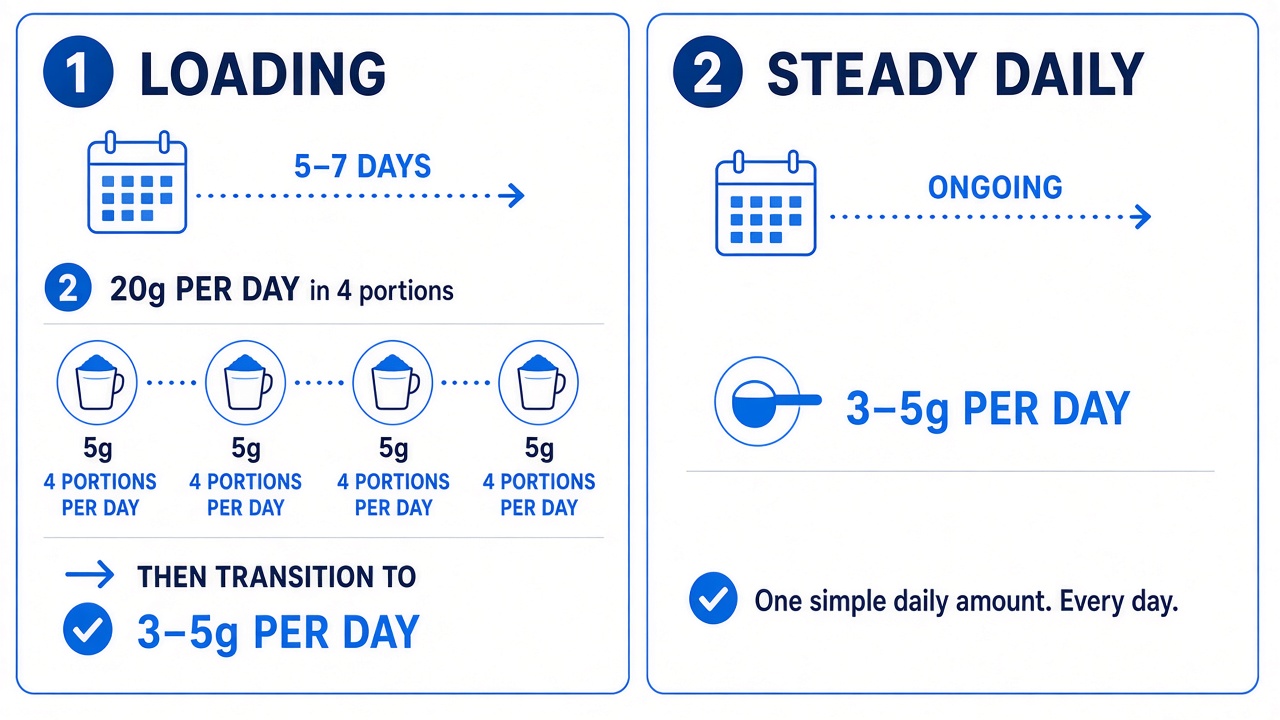
1. The Loading Protocol (Fast Saturation) According to the NIH, a common method to saturate muscle stores rapidly is the “loading phase.” This involves taking 20 grams of creatine daily for 5 to 7 days, split into four 5-gram servings to minimize gastrointestinal distress. Afterward, transition to a maintenance phase of 3 to 5 grams per day.
- Benefit: Muscle saturation and performance benefits occur quickly, typically within one week.
- Drawback: Higher risk of bloating and mild digestive upset during the loading week.
2. The Daily Maintenance Protocol (Gradual Saturation) Alternatively, skip the loading phase and consume 3 to 5 grams per day from day one.
- Benefit: Highly convenient, gentler on the digestive system, and minimizes the risk of sudden bloating.
- Drawback: It takes roughly 3 to 4 weeks of consistent supplementation to reach maximum cellular saturation.
Both methods achieve fully saturated muscle creatine stores. The choice depends on how quickly you wish to see effects versus your digestive sensitivity.
What “Water Weight” Means
A common concern among shoppers monitoring their body weight is creatine-induced weight gain. It is vital to distinguish between fat accumulation and cellular hydration.
Creatine is osmotically active; as it enters muscle cells, it pulls water with it. This increases total body water localized almost entirely inside the muscle tissue (intracellular fluid), creating the “water weight” noticed in the first few weeks (typically 1 to 4 pounds).
This intracellular hydration is a positive physiological state. Well-hydrated muscle cells are less prone to breakdown. It does not cause a bloated look under the skin (subcutaneous water retention). Instead, the water is drawn deep into the muscle belly, making it look denser. Upon ceasing supplementation, this specific water weight dissipates over a few weeks.
Safety

For healthy adults without pre-existing renal (kidney) or hepatic (liver) conditions, creatine monohydrate boasts an exceptional safety profile. The NIH Office of Dietary Supplements explicitly states it is safe for healthy adults at recommended doses. Decades of longitudinal studies tracking continuous use reveal no adverse health markers.
The primary reported side effects are generally mild:
- Gastrointestinal Distress: Nausea, diarrhea, and stomach cramping can occur. This is almost exclusively associated with taking too much creatine at once (e.g., a 20-gram single dose) or taking it on an empty stomach with insufficient water.
- Dehydration Risk: Because creatine pulls water into the muscle cells, maintaining adequate daily water intake is a fundamental requirement to ensure overall systemic hydration.
- Kidney Stress Myth: A persistent myth suggests creatine damages kidneys, stemming from a misunderstanding of a biomarker called creatinine (a natural waste product of creatine metabolism). Supplementing creatine naturally raises blood creatinine levels slightly. In healthy adults, this simply reflects increased muscle creatine turnover, not a failure of kidney filtration. However, individuals with pre-existing kidney disease must consult a healthcare provider before use.
Frequently Asked Questions
Does creatine cause hair loss? The concern stems from a single 2009 study involving rugby players showing that creatine increased DHT, an androgen linked to male pattern baldness. However, the study measured hormone levels, not actual hair loss. Subsequent larger studies have repeatedly failed to replicate these findings or find a direct clinical link between creatine monohydrate and hair loss in healthy adults.
Should I take creatine on rest days? Yes. Creatine works by maintaining a saturated level in your muscle cells. Since it is not an acute stimulant, taking it only on workout days will cause cellular stores to fluctuate and deplete. A daily maintenance dose of 3–5 grams is required to maintain saturation, regardless of exercise activity.
When is the best time to take creatine? Exact timing has a very minor impact on overall efficacy. Some research suggests a slight benefit to taking it post-workout alongside carbohydrates and protein, as the insulin spike may help drive creatine into cells. However, consistent daily consumption is by far the most important factor. Choose a convenient time so you won’t forget.
Do I need to “cycle” off creatine? No. Early hypotheses suggested continuous use might down-regulate the body’s natural creatine production. Long-term studies show this is false; the body resumes natural production seamlessly upon cessation. There is no physiological requirement to cycle on and off; it can be safely taken year-round by healthy adults.
Related
Medical Disclaimer
The information provided in this article is for educational and informational purposes only and is not intended as medical advice. Dietary supplements are not intended to diagnose, treat, cure, or prevent any disease. Always consult with a qualified healthcare professional before starting any new dietary supplement regimen, especially if you have pre-existing health conditions or are taking prescription medications.
Sources
- National Institutes of Health (NIH) Office of Dietary Supplements: Exercise and Athletic Performance Fact Sheet. Available at: https://ods.od.nih.gov/factsheets/ExerciseAndAthleticPerformance-HealthProfessional/